What is a palimpsest ghost sign? A wall carrying two or more painted advertisements at once, where the newest layer has faded enough to let older ones show through — palimpsest ghost signs are layers that were never meant to be read together.
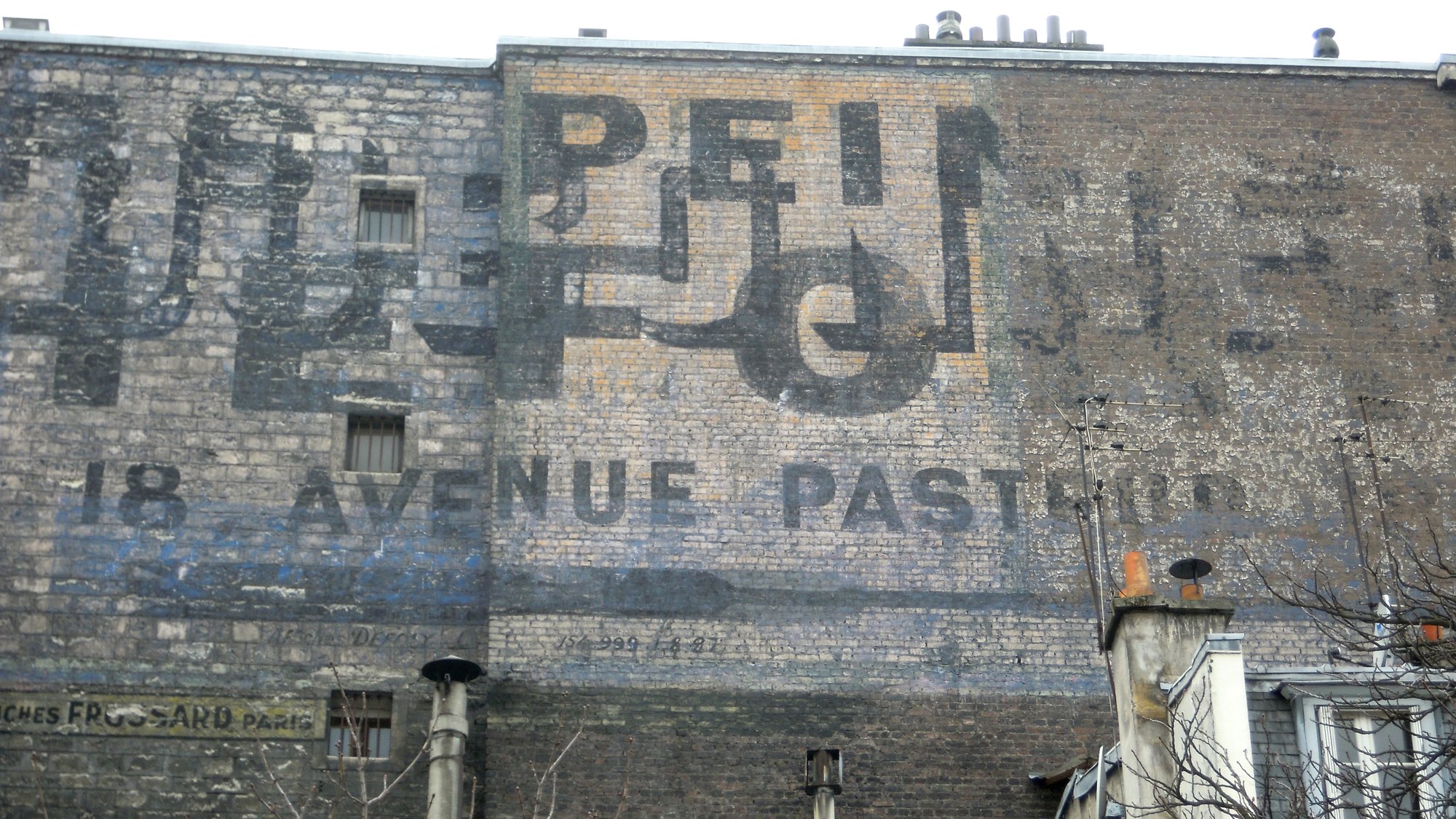
Key Takeaways
- Two layers is the threshold. Sam Roberts and Geraldine Marshall define a palimpsest as “the appearance of two or more signs in a single location” — What is a Ghost Sign? (Routledge, 2017)
- Lead is why the old layers come back. Lead content in sign paint peaked over 1930–1955; lead-bearing paint bonded to masonry instead of peeling off it.
- A single wall can hide 25 layers. Restorers took 25 layers of paint off the 1894 Coca‑Cola wall in Cartersville, Georgia to reach the original — Cartersville Museum City
- Layers disagree with each other. On one Stoke Newington wall, Gillette (still trading) sits alongside Criterion Matches and the Westminster Gazette (both long gone) — which breaks any single “is this business still active?” test.
- Over 1,000 signs are catalogued in the History of Advertising Trust Ghostsigns Archive, built by more than 150 photographers since its launch on 18 March 2010.
- The term is borrowed, not native. “Palimpsest” comes from manuscript studies — parchment scraped clean and rewritten, with the earlier text still showing.
What is a palimpsest ghost sign?
A palimpsest ghost sign is a single wall carrying two or more hand-painted advertisements that are visible at the same time. It happens when the most recent coat of paint weathers faster than the ones underneath it, so an older campaign surfaces through a newer one.
The definition that ghost-sign researchers actually work from is deliberately narrow. In “What is a Ghost Sign?”, their chapter in the Routledge collection Advertising and Public Memory, Sam Roberts and Geraldine Marshall write:
A palimpsest is the appearance of two or more signs in a single location, typically due to a more recent layer of paint gradually fading to reveal earlier painted layers below.
Sam Roberts & Geraldine Marshall, What is a Ghost Sign?, 2017
Two things in that sentence do real work. Two or more sets the floor — one faded advertisement is a ghost sign, not a palimpsest. And a single location keeps it to one wall: two signs on adjacent buildings are two signs, however photogenic the pairing.
If you are new to the wider subject, the general guide to ghost signs covers the trade, the paint and the decline of wall advertising. This article is about the harder case — what to do when a wall is telling you several things at once.
Where does the word “palimpsest” come from?
It comes from manuscript studies, not from advertising. A palimpsest was a sheet of parchment scraped or washed clean so it could be written on again — an expensive material being reused. The erasure was rarely complete, so the earlier text stayed faintly legible beneath the new one.
Roberts and Marshall are explicit that the borrowing is recent and local to the field. The term, they note, “has been appropriated within ghost signs circles from its original usage describing the washing or scraping away of text from parchment or manuscripts for the purposes of re-use.”
The metaphor survives the jump intact because the mechanism is genuinely similar: a surface too valuable to abandon, reused, with the previous occupant never quite erased. A gable wall facing a railway line was prime advertising space for seventy years. Nobody demolished it between campaigns; they painted over it.
The parent term arrived later than you might expect too. William Stage’s 1989 book Ghost Signs: Brick Wall Signs in America is the earliest recorded use of “ghost sign” for historic signage — and Stage told Roberts he got the phrase from his publisher: “Up until then I think I called them wall signs.”
How do you read the layers on a palimpsest wall?
Start by accepting that you are looking at several objects, not one. Roberts and Marshall reach the same conclusion after testing their own criteria against real walls: the workable approach is “to treat them as multiple objects, analysing each independently.”
In practice, four signals separate the layers.
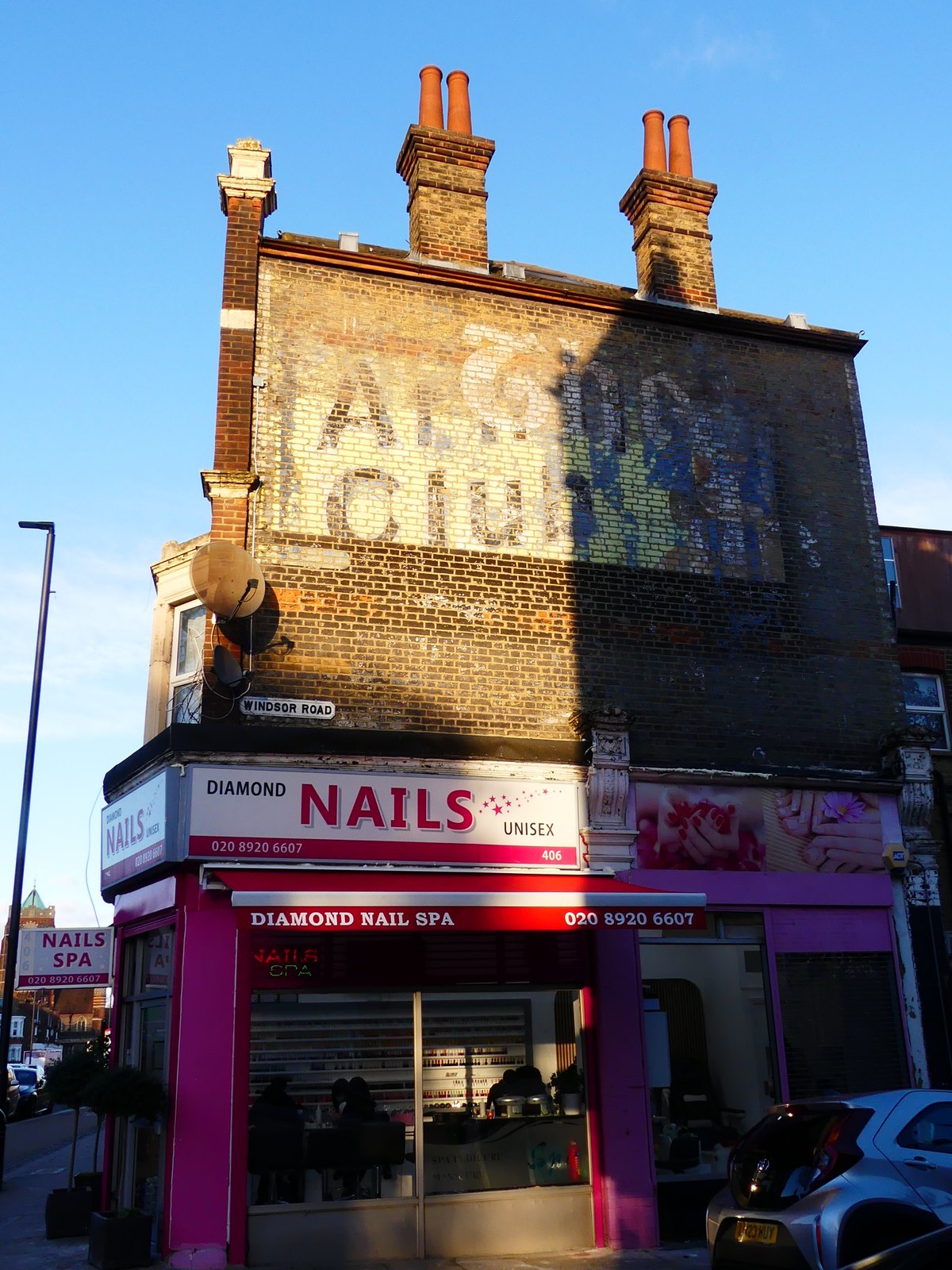
- Opacity and colour. White-lead paint outlasted every other pigment, so the palest, chalkiest lettering is usually the oldest surviving layer rather than the newest.
- Edges. A layer painted over another usually has cleaner, harder edges where it is intact. The layer beneath shows as a soft ghost with no crisp boundary.
- Typography. Letterforms date a campaign faster than the product does. A shaded Victorian slab serif and a 1950s sans on the same wall are two different decades of signwriting.
- Registration. Layers rarely line up. Text running at a slight angle to the newer layer, or breaking off mid-word at the edge of a later panel, is the older campaign.
Why do older layers reappear at all?
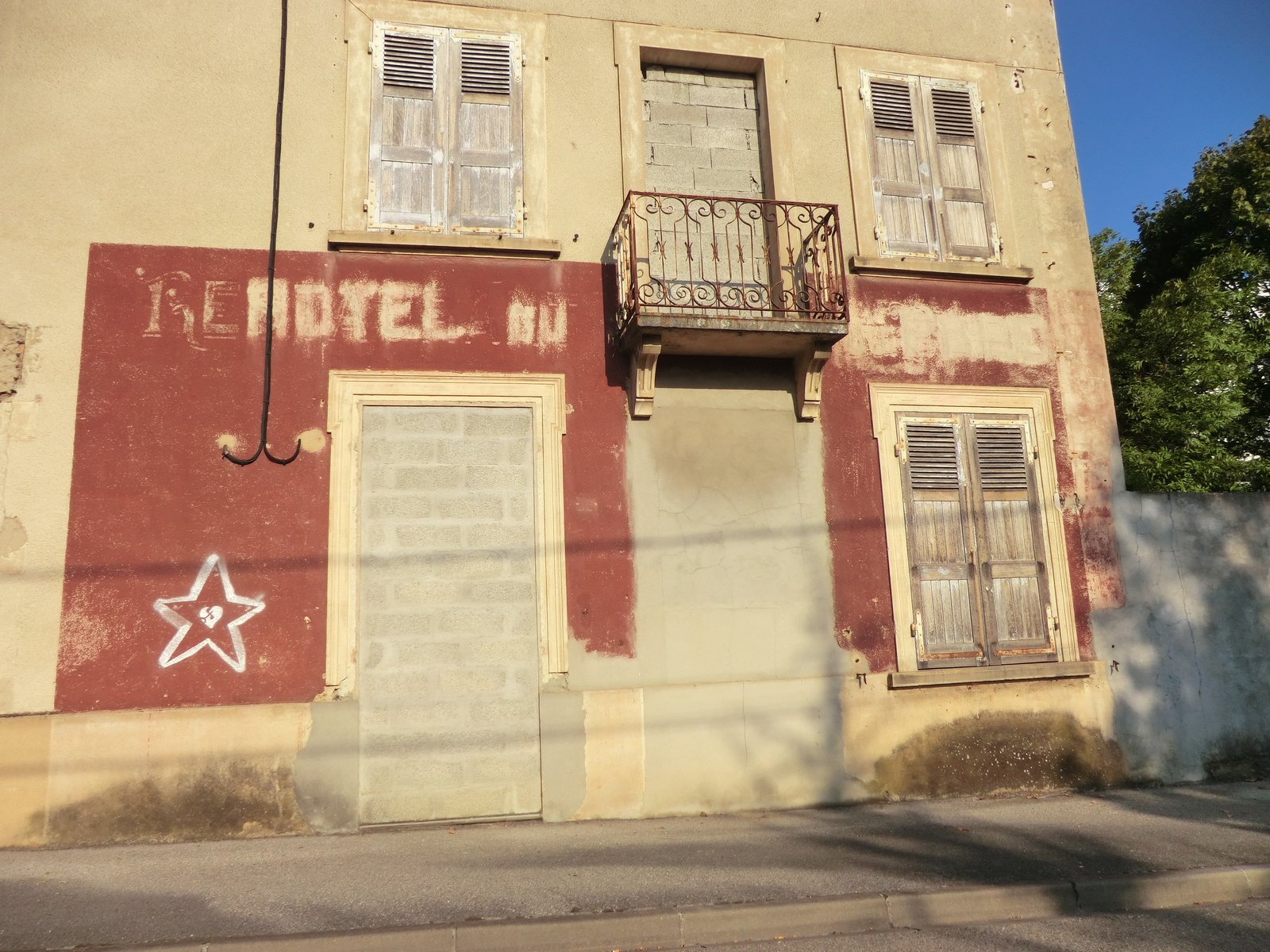
Because the paint underneath was better. Sign paint of the period was mixed on site from linseed oil, pigment, driers and white lead, and lead is the reason so much of it is still legible. Lead-bearing paint bonded into the masonry rather than sitting on top of it, and the oldest coats effectively stained the brick.
That gives a counterintuitive rule: durability runs backwards through the stack. The 1905 layer may well outlast the 1955 layer painted on top of it, because the later coat contained less lead and behaved more like a modern film — peeling off in flakes rather than fading in place. Lead content in sign paint peaked in the period 1930 to 1955, then fell away as lead was regulated out.
It also explains why palimpsests keep changing. A wall photographed in 2009 and again in 2026 is often not the same document: another few winters of frost have taken more of the top layer off, and a little more of the one below has surfaced.
How does a palimpsest differ from an ordinary ghost sign?
An ordinary ghost sign is one object you can classify. A palimpsest breaks the classification, which is exactly why researchers treat it as its own category.
| Test | Single ghost sign | Palimpsest | Faux ghost sign |
|---|---|---|---|
| Number of signs present | One | Two or more, same wall | One |
| Is the business still trading? | One answer | Can be yes and no at once | Usually yes — it is current advertising |
| Level of fading | Consistent across the sign | Varies by layer | Painted to look faded |
| Text or illustration? | One answer | Can differ layer to layer | One answer |
| Caused by weathering? | Yes | Yes | No — the effect is deliberate |
The Stoke Newington wall Roberts and Marshall use makes the problem concrete. Three layers are legible: Gillette, Criterion Matches and the Westminster Gazette. Gillette is a going concern; the other two are long dead. Ask “does this sign advertise a business that still exists?” and the wall returns two contradictory answers at once.
Not every palimpsest is paint over paint, either. Roberts and Marshall note a Boots the Chemists wall in Camden where a lit or neon sign was fixed over a painted one, and parts of both now survive — the layers differ in medium, not just in date.
What does a palimpsest tell you that a single sign cannot?
Sequence. One ghost sign is a snapshot of a business at a moment. A palimpsest is a stratigraphy — the same commercial spot, re-let across decades, with each tenant recorded in the order they arrived.
That makes these walls unusually good evidence. A trade directory tells you a firm existed at an address; a palimpsest tells you what came before it and what displaced it, on the actual fabric of the building. The Coca‑Cola wall crews worked this way at scale — the same prime walls were repainted on a cycle, each pass burying the last.
Cartersville, Georgia is the extreme case. The Coca‑Cola advertisement painted there in 1894 by a syrup salesman named James Couden — authenticated by the company as its first outdoor painted wall advertisement — sat under 25 layers of paint until a restoration brought it back. The wall was restored and authenticated in 1994. Twenty-five layers is a century of commercial history on one gable end.
What do people get wrong about palimpsest ghost signs?
“The faintest layer is the newest.” Usually the reverse. White lead deteriorated slowest of all the pigments, so the pale chalky lettering is often the oldest coat, not the most recent one.
“Overlapping signs mean the business failed.” They mean the wall was re-let. Prime advertising walls were repainted on a commercial cycle regardless of how any individual tenant fared — in 1914 a site on Vauxhall Bridge Road in London cost £30 to hire for a year.
“A palimpsest should be restored to its best layer.” Restoring one layer destroys the others. The Cartersville restoration was defensible because the target was a documented first; stripping an undocumented wall to whichever layer photographs best is data loss, not conservation.
“If it looks faded, it is old.” Roberts and Marshall flag “faux” ghost signs as a real classification problem — some are painted to appear faded from the start, and telling them apart “requires external contextual information” rather than a look at the wall.
Frequently asked questions
How many layers does a wall need to count as a palimpsest?
Two. Roberts and Marshall set the threshold at “two or more signs in a single location”, so a wall with one faded advertisement is a ghost sign, and a wall with two is a palimpsest.
Is “palimpsest” an official heritage term?
No. It is borrowed from manuscript studies and used informally within ghost-sign research and enthusiast circles. Roberts and Marshall describe it as “appropriated” from the parchment sense, and propose the more neutral “fading painted signs” as a working definition for the wider category.
Why can I read a 1900s advertisement but not the 1950s one painted over it?
Paint chemistry. Earlier coats carried more white lead, which bonded into the masonry and faded slowly in place. Later paints contained less lead and behaved like a surface film, so they flaked away and took their own lettering with them.
Do palimpsests change over time?
Yes, continuously. As the top layer weathers, more of the layer beneath emerges. A wall photographed a decade apart frequently shows different combinations of legible text, which is why dated documentation matters more here than for a single stable sign.
Can a palimpsest include non-painted signs?
Yes. Roberts and Marshall cite a Boots the Chemists wall in Camden, London where a lit or neon sign was mounted over a painted one; remains of both are now visible, so the layers differ in medium as well as in date.
Where can I look up documented examples?
The History of Advertising Trust Ghostsigns Archive is a free searchable collection of over 1,000 signs from across the UK and Ireland, launched on 18 March 2010 and built by more than 150 photographers.
Should a palimpsest be repainted or left alone?
There is no settled rule, and the two goals conflict: repainting one layer necessarily erases the others. Documenting the wall photographically before any intervention preserves the sequence even when the paint cannot be kept.
Methodology and sources
This article is built from published sources, each linked at the point of the claim. The primary reference is Sam Roberts and Geraldine Marshall’s chapter “What is a Ghost Sign?” in Advertising and Public Memory (Routledge, 2017), read in full rather than summarised from a search result; the definitions and the Stoke Newington and Camden examples come from that chapter.
What was checked and what was left out. The Cartersville figure of 25 layers is reported by Cartersville Museum City; Explore Georgia dates the restoration and authentication to 1994, while other secondary accounts give 1989–1990 for restoration work and an award. Because those dates conflict, only the 1894 painting date and the 25-layer figure are stated here, and the restoration is described without a year. Two archive counts also disagree — an earlier trade article cites “over 600 signs” where the project’s own current page says over 1,000; the higher, more recent figure is used and attributed. No claim in this article rests on a search-result snippet.
Images. All three photographs are real, licensed images sourced from Wikimedia Commons, credited in their captions with photographer, date, licence and a link to the catalogue record. Nothing here is AI-generated. One strong candidate photograph (a palimpsest at Regent Square, WC1) was rejected because its largest available version is 576×1024 px, below the 1200 px threshold for a primary image; it was not upscaled.
Internal linking. This site currently publishes two other articles, both linked above. The usual target of eight or more internal links is not met because that many relevant pages do not yet exist.
AI assistance. This article was researched and drafted with AI assistance, then fact-checked against the linked primary sources.