 By Zoltan · Creator of Faded Main Street, a YouTube channel documenting vanished Americana — ghost signs, lost buildings, and discontinued products. | Last updated: July 2026

The Men Who Painted America Red — the full film on the Faded Main Street channel.
Coca-Cola ghost signs are the faded remains of the largest hand-painted advertising campaign in American history — more than 16,000 brick walls, painted and maintained by traveling crews from 1894 until the 1950s.
Key Takeaways
- The first Coca-Cola wall sign was painted in 1894 on Young Brothers Pharmacy in Cartersville, Georgia, by syrup salesman James Couden — who misspelled “Drink” and fixed it by squeezing in an “i”.
- Over the life of the program the company and its bottlers painted as many as 16,000 wall murals across the United States.
- By 1910 roughly a quarter of Coca-Cola’s entire advertising budget went into painted walls.
- Building owners said yes because of the privilege sign — free professional signage carrying the merchant’s own name alongside the brand’s.
- The crews were wall dogs working to a corporate standard, hand-lettering Spencerian script identically from Mississippi to Montana.
- The program expanded through the Great Depression: Robert Woodruff’s “The Pause That Refreshes” launched in 1929 and the company spent while rivals cut back.
- Restorers reaching Couden’s original brushwork in Cartersville had to strip 25 layers of paint — one for each return visit by the crews.
What Are Coca-Cola Ghost Signs?
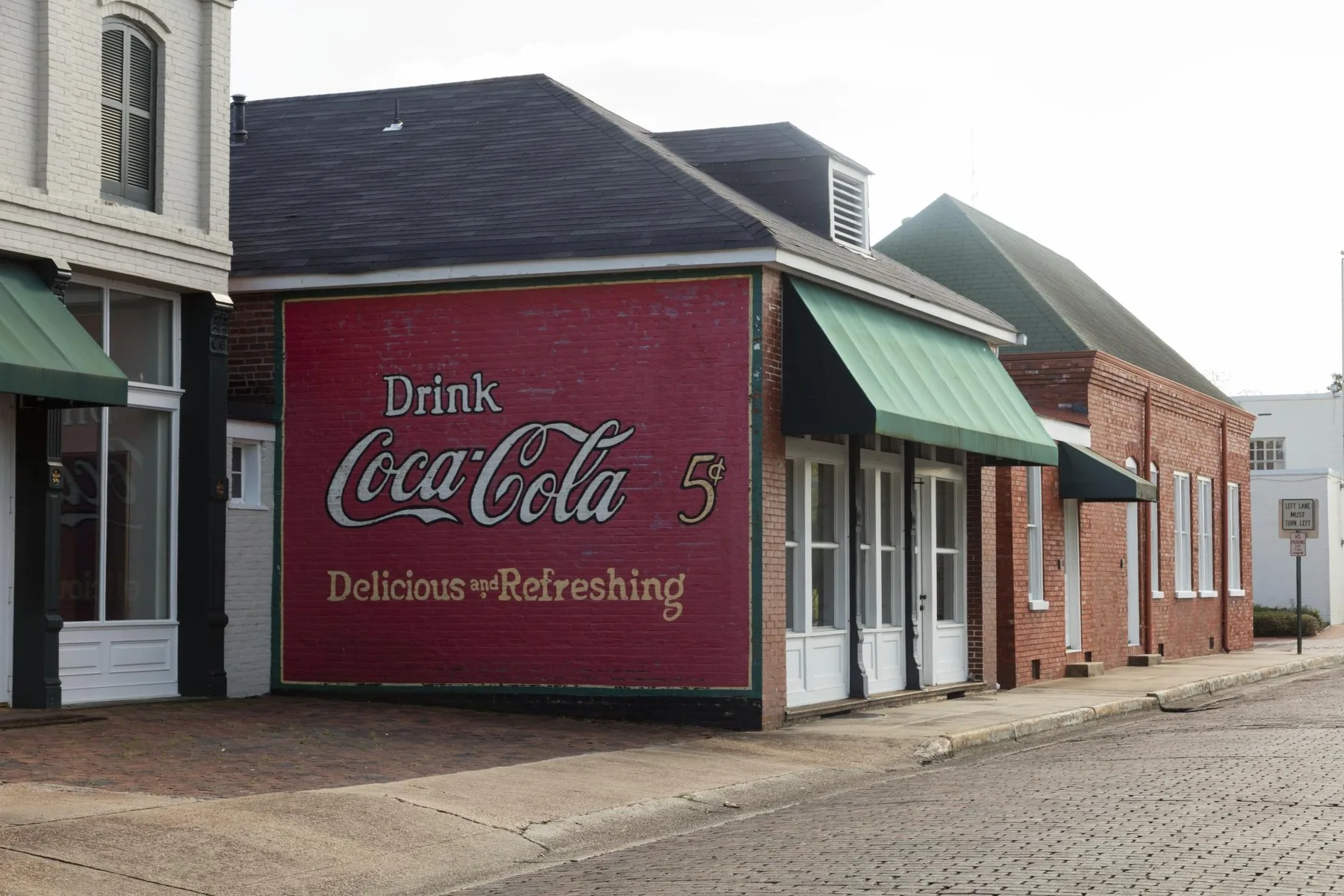
Coca-Cola ghost signs are painted wall advertisements for the drink, applied directly to brick between the 1890s and the 1950s and left to weather ever since. They are the single largest family of American ghost signs, because no other advertiser painted on anything like the same scale.
What separates them from an ordinary faded ad is that they were never really local. A sign painted on a feed store in Tennessee used the same script, the same registered colors and the same layout as one in Oregon, because both were executed by traveling crews working to a standard set in Atlanta.
The story of how they got there begins with a blank wall, a salesman, and a spelling mistake.
Where Did the First Coca-Cola Wall Sign Come From?
In 1894 a syrup salesman named James Couden was looking at the side of Young Brothers Pharmacy in Cartersville, Georgia — a large blank brick wall facing the railroad tracks. Coca-Cola was eight years old, sold only by the glass at drugstore soda fountains, and almost nobody knew what it was.
Couden’s idea was that the wall itself could do the selling to the trainloads of travellers rolling past. He put down his order pad and painted “Drink Coca-Cola” on the brick — the advertisement the company has authenticated as the first outdoor painted wall ad in its history.
And he got it wrong. Working freehand, he misspelled the very first word, then corrected it on the fly by squeezing an “i” into “Drink” so neatly that most people never noticed. The fix is still visible on close inspection. The largest painted-wall campaign in advertising history opens with a salesman improvising a spelling correction, brush in hand, on the side of a drugstore.
Asa Candler, who had bought the formula a few years earlier and was among the most aggressive marketers of his era, understood what the wall meant. If one painted wall could pull passengers into one pharmacy, thousands could introduce the drink to a country that had never heard of it. He commissioned painters to fan out across the country.
Why Did Coca-Cola Bet a Quarter of Its Budget on Brick?
Because in an era before radio, television or neon, a wall facing traffic was the only mass medium a company could actually buy. By 1910 roughly a quarter of Coca-Cola’s entire advertising budget was going into painted walls — not into print, but into brushes, paint, scaffolds and crews.
The company painted the same message from Georgia to Oregon: on pharmacies, general stores, feed warehouses and barns, anywhere a wall faced a road. It was not alone up there. Mail Pouch Tobacco was blanketing rural barns in the same decades, and every wall a competitor claimed was one the crews wanted back.
How Did Coca-Cola Get Thousands of Building Owners to Say Yes?
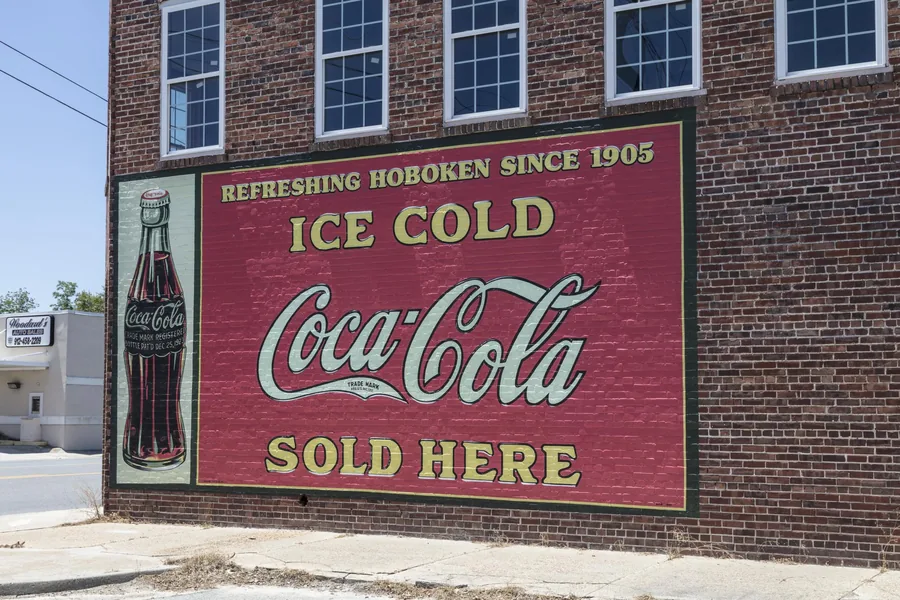
With one of the cleverest arrangements in advertising history: the privilege sign. A crew would offer to paint a merchant’s wall or sign board for free — fresh paint, professional lettering, the store’s own name in handsome type. The catch was that the same design also carried the advertiser’s message.
The merchant got signage he could not otherwise afford. The company got prime position on Main Street. The name comes from the advertiser’s side of the deal: the free sign bought the privilege of the space. Coca-Cola took the format seriously enough to publish a guide for its people, The Art and Craft of Privilege Signs.
| The privilege-sign bargain | What the merchant got | What the advertiser got |
|---|---|---|
| Immediately | A freshly painted wall or sign board, free | Space on a building facing traffic |
| The design | His own store name in the dominant position | The brand name and slogan on the same panel |
| Over time | Free repainting when the crews came back | A maintained sign, kept legible for decades |
| The catch | The wall now sells someone else’s product too | Cost of paint and labor, far below print rates |
A note on scope. The privilege sign is best documented as a storefront format — the painted or metal panel carrying a shop’s name above a brand band — and it was most common from the 1930s to the 1960s. It explains how advertisers got access to buildings, but not every one of the 16,000 painted walls was a privilege sign; many were straightforward paid or negotiated placements.
Who Were the Crews That Painted the Walls?
They were the traveling craftsmen the trade called wall dogs — but the crews on the big national accounts worked at a different level from a lone painter improvising. These were organized teams executing standardized designs, with the logo drawn to specification and colors mixed to match.
The flowing white lettering was Spencerian script, the nineteenth-century penmanship style the company adopted as its trademark, and it had to look identical whether it went up in Mississippi or Montana. That is the demanding part: a hundred feet of brick, hand-lettered in a script face, to a standard set in an office hundreds of miles away.
The crews moved town to town with scaffolds and paint, laying out enormous letters with chalk lines and a practiced eye, working high above the street in heat and wind. A team could transform the side of a building in a day or two, pack up, and move to the next town on the route.
How Did the Sign Crews Survive the Great Depression?
You would expect a campaign like this to collapse in the 1930s, when advertising budgets across America were cut to the bone. It did the opposite — and the reasons are practical.
Painted walls were cheap next to other national advertising. The privilege-sign offer became more attractive to a merchant who could not afford paint of his own. And under president Robert Woodruff the company was famously willing to spend while competitors retreated: “The Pause That Refreshes” launched in 1929, on the edge of the crash, and positioned the drink as a five-cent moment of relief.
For the painters, the work was a lifeline. In a decade when roughly a quarter of the country was out of work, a man who could letter a wall to standard had a trade that fed his family. The crews kept traveling and the walls kept going up during the years when much else was falling apart — which is why so many surviving signs carry Depression-era slogans.
Why Were the Same Walls Repainted for Decades?
Because the company maintained what it built, and this is the detail that separates the operation from every local sign job around it. The walls were repainted on a schedule; crews returned year after year to refresh the same signs.
The Cartersville original is the clearest evidence. When the pharmacy’s owner had it restored in 1989, reaching James Couden’s 1894 brushwork meant removing 25 layers of paint — layers stacked like the rings of a tree, each one a return visit by a crew.
That maintenance schedule is also why the signs survive at all. A wall repainted every few years for half a century carries far more paint than a one-off advertisement, and it is that accumulated depth that is now weathering slowly into a ghost.
What Ended the Painted-Wall Era?
Four forces, arriving together after the Second World War — and the timeline below is the whole arc in one view.
The highways moved the traffic. New roads pulled drivers out of the downtowns where the walls stood, and a sign only works where the traffic is.
The law caught up. In 1965 the Highway Beautification Act put federal limits on outdoor advertising along those roads, closing the era of the unregulated wall. A 1974 amendment later carved out an exemption for “landmark signs” of historic or artistic significance.
The technology changed. Neon and electric signs made painted brick look like the past, and printed billboards could be produced in a workshop and pasted up in an afternoon — no scaffold, no crew, no return visits.
The money left. Television reached every living room in the country and the advertising budgets followed. By the 1950s the great wall-painting programs were winding down. The crews came off the road, the scheduled repainting stopped, and the walls were left to the sun and the rain.
Where Can You Still See Coca-Cola Ghost Signs?
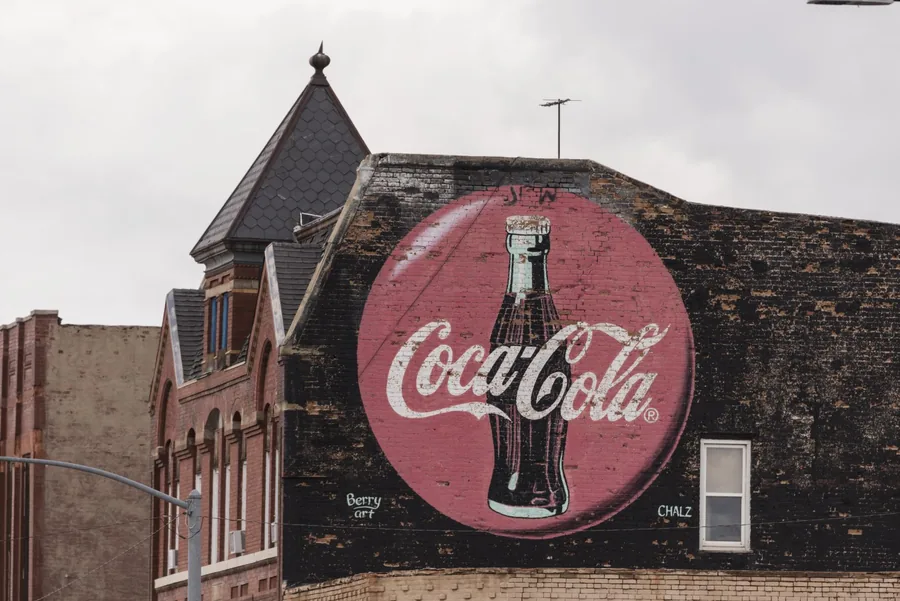
Almost anywhere with a pre-war commercial district. Because the crews covered so much ground and painted so many coats, survivors are more common than for any other advertiser. Here is where to look:
- Walls facing former rail lines. The 1894 original faced the tracks for a reason — that was the traffic.
- The side and rear of corner buildings, especially where a neighboring building has since been demolished.
- Feed stores and rural general stores. The campaign went well beyond towns.
- Under later signage. Repainting means a Coca-Cola ghost sign is often layered with something else; look for script bleeding through a later block-letter ad.
- Restored examples. Cartersville’s is preserved and marked; several bottlers have funded restorations of their local walls.
One caution worth carrying: a bright, crisp wall is usually a restoration or a modern replica, not a survivor. The restore-or-let-it-fade debate applies here more than anywhere, precisely because these signs have a corporate owner with an interest in keeping them legible.
See These Walls in Motion
The Faded Main Street project documents America’s ghost signs — the crews, the brands, and the walls they left behind — in short documentary films. Start with the story behind the project, or watch on YouTube.
Coca-Cola Ghost Signs FAQ
What is a Coca-Cola ghost sign?
A painted wall advertisement for Coca-Cola, applied to brick between the 1890s and the 1950s and left to weather. They are the most common surviving ghost signs in America because the campaign covered as many as 16,000 walls.
Where is the first Coca-Cola wall sign?
On the side of Young Brothers Pharmacy in Cartersville, Georgia, painted in 1894 by syrup salesman James Couden. The company has authenticated it as the first outdoor painted wall advertisement in its history, and it is still on view.
Did the first sign really contain a spelling mistake?
Yes. Couden misspelled “Drink” and corrected it by squeezing an “i” into the word rather than starting over. The fix is subtle enough that most viewers never notice it.
What is a privilege sign?
Signage supplied free to a shopkeeper by a manufacturer, carrying the shop’s own name alongside the manufacturer’s branding. The merchant got signage he could not otherwise afford; the advertiser got the “privilege” of the space.
Why is the lettering in that particular script?
It is Spencerian script, a nineteenth-century American penmanship style adopted as the trademark. Crews had to reproduce it by hand to a corporate standard, at building scale, in every town they worked.
Why did the campaign grow during the Great Depression?
Painted walls were cheap compared with other national advertising, free signage was especially appealing to struggling merchants, and the company deliberately spent while competitors cut back. For the painters themselves, it was steady work in a decade with little of it.
Are the surviving signs protected?
Some are. The 1974 amendment to the Highway Beautification Act allows states, with federal approval, to designate pre-1965 “landmark signs” of historic or artistic significance. That is a statutory category, not a National Park Service designation.
Zoltan — Creator of Faded Main Street, a YouTube channel documenting vanished Americana — ghost signs, lost buildings, and discontinued products.